SVETLANA ALEXIEVICH – A BOLD CHOICE FOR THE NOBEL…OR IS IT?
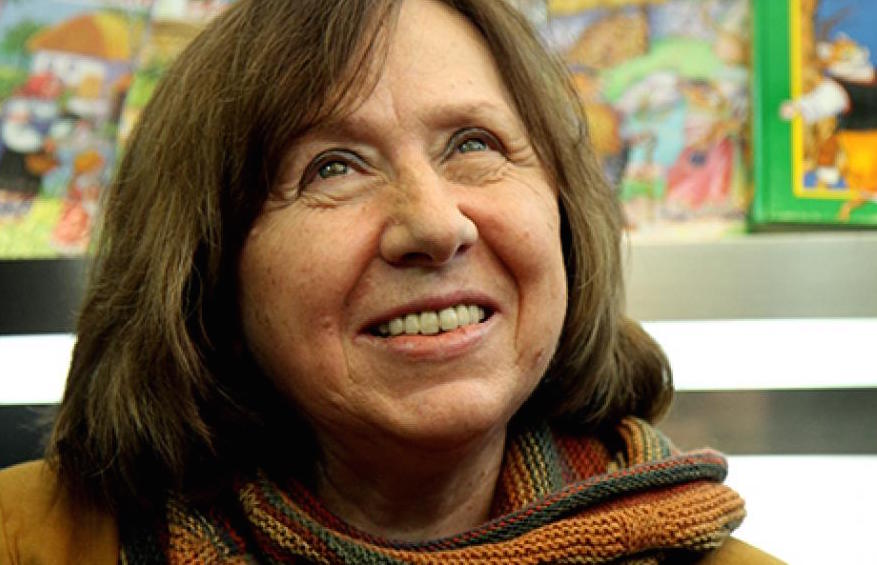
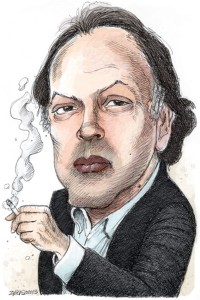
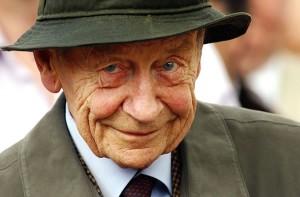
Svetlana Alexievich, 2015 Nobel Laureate
Nobel laureates Theodor Mommsen, Rudolph Eucken, Henri Bergson, Bertrand Russell, and Winston Churchill have spent many decades receding from memory. To be sure, they are not altogether lost, a century and some is not long enough in the modern era for total erasure. Churchill’s name we know, albeit for other reasons. Russell’s and Bergson’s have a familiar echo. A few historians whose specialty is ancient Rome know something of Mommsen. Eucken has all but vanished. A dustier collection of books never hid along the nether reaches of the library stacks.
Today the Belorusian writer Svetlana Alexievich joined their ranks, becoming the sixth writer to be awarded the world’s most prestigious literary prize for work that is neither fiction, nor poetry, nor drama. That is to say, nothing of what is almost universally meant by “literature”. One would like to say that her being so honored could blow some of the dust off the other five’s books, renew interest in their achievements. It is not likely. One would also like to say that she will not share there fate, once a similar number of decades have past. This no one can say. What can be said is even within this small group, she is in a minority of one, winning not for history, or philosophy, but for journalism. More an occupation, you would be forgiven for thinking, than a literary pursuit, although many writers have done time as journalists. It seems ever more a thing of the past that an aspiring novelist, following the Hemingway model, would consent to an apprenticeship of investigative journalism to make ends meet during their early careers. So, on a list of eminences such as Peter Nadas, Antonio Lobo Antunes, Philip Roth, and Adam Zagajewski, all potential candidates for the Nobel, it is easy to view Alexievich’s work as déclassé. Admirable, to be sure, even important. But literature?
We should, perhaps, take another look. She is, after all, a writer. Voices from Chernobyl, and Zinky Boys are, in fact, books, and, by all accounts, the quality of the writing they exhibit is high and the formal innovation worthy of note. Further, they are books which shoulder the burden of their gravely difficult content without stumbling. In light of these considerations, perhaps we must confess a bias that begs challenging.
That said, the award of the day really should go to the Nobel committee itself for pulling off a bit of a stunt. They succeeded in being simultaneously progressive and conservative, edgy and drearily establishment. They have, on the one hand, cracked open the whole idea of what constitutes literature – and this is a very good thing as there are many great writers waiting on the margins (In a texting exchange with my friend Nathan yesterday, he asked why there has been such a buzz about a possible win for Svetlana Alexievich while no one is talking about Elena Poneiatowska. As with so many of the authors I hear about from Nathan, I had to google her. I learned that she is a Mexican journalist, winner of the hugely prestigious Cervantes Prize, who has, among her many and lofty credits, a book called La Noche de Tlatelocloco, containing testimonies of the victims of the 1968 student massacre in Mexico City. Thank you, Nathan, as always.)
So. Good for Stockholm. On the other hand, the choice of Alexievich harkens back to the blandest, most conservative interpretation of Alfred Nobel’s poorly worded will which stipulates that the award should go to “the person who shall have produced in the field of literature the most outstanding work in an ideal direction.” In the early years of the award the term “ideal direction” was interpreted to mean something like “edifying”, “uplifting”, “holding to high ideals”. Basically, it was set up to reward literature that was “good for you,” and, by implication, to penalize literature that was, somehow, not. And so, instead of giving the award to Emil Zola, Henrik Ibsen, Thomas Hardy, or James Joyce, each of whose work was considered in one way or another unwholesome, the award went to writers startling in their mediocrity, like Karl Adolph Gjellerup “for his varied and rich poetry, which is inspired by lofty ideals”. Over the decades, the interpretation has shifted in various ways. Sometimes it has been taken to mean consonant to the great humanistic project, thereby enabling the committee to honor such worthy writers as Romain Rolland and Boris Pasternak. But however the committee interprets it, they are saddled with the idea of literature being taken in a particular “direction.” It is a hopelessly moralistic project, which, somehow, the very best writers to be honored – Shaw, Faulkner, Mann, Beckett, Marquez, Eliot, and a handful of others – have transcended. Or, conversely, the Swedish Academy itself has occasionally been able to transcended the limitations of Nobel’s will so as to perceive these writers as great artists, ideal or not.
The committee will claim that “idealism” is no longer a concern, that it is an outmoded criterion, and that only the “best” writing is considered. But listen to Permanent Secretary Sara Danius’s post-announcement comments about Svetlana Alexievich. She says that this remarkable writer has been involved in a project of “mapping the Soviet, and post-Soviet, individual,” of writing down “a history of the human being about whom we really didn’t know that much, at least not in this systematic manner,” of documenting “a history of emotions, a history of the soul, if you wish.” These are all extra-literary concerns, all driven by unassailable “ideals.”
I have not yet read Svetlana Alexievich’s books. I have no reason to doubt that she is a significant writer. She certainly seems to be an important one. Perhaps she is even a great one. I look forward to finding out.
In trying to nail down the genesis of my interest in the Nobel Prize, the best I’ve been able to come up with is that that when I was four years old I fell down the stairs. It was my first memorable lesson in the randomness of things. “How could this have happened?” screamed my young consciousness and in that moment I realized something had to be done about an environment disorderly enough to permit such a humiliation. In the interest of personal safety, I adopted various policies, such as refusing to listen to any one of my long-playing records until I had listened to all of them, in order. Take that, ye dark powers! The Swedish Academy often appears to obey some similarly recondite logic; the announcements, and pronouncements, are delivered, against general bewilderment, with bracing assurance, like a child explaining exactly why it is necessary to check for dandelions in his breakfast cereal. They say “This. This one here has made all the difference,” thereby holding at bay, or seeming to, or at least to their own satisfaction, the whole chaotic ocean of contemporary literature. The Nobel Prize is a hedge against a universe where, with a single misstep one can tumble down a never-ending staircase.
There is a character in László Krasznahorkai’s novel Seiobo There Below whose passion for baroque music is so fierce that he can only view the music of any other era as inferior, Mozart and Beethoven notwithstanding. The reader wonders how it came to be that the full scope of music throughout history poses such a threat to his sensibilities that he must set this rigid limitation. Yet we are sympathetic. He’s the kind of person we would be loathed to sit next to on a flight or on the bus, but, from the safe distance of the printed page, we quietly admire his dedication, and, even more, his capacity to love something so much. Besides, we think, the world needs its quota of cranks. But he becomes an object of tragic fascination insofar as he is unable to live alone with this passion. He must share it. Which is to say, he must share the unsharable. He is profoundly overweight, because, we sense, his lone and hermetic yearning swells within him. He gives a lecture in the library of a small town’s cultural center, entitled “A Century and a Half of Heaven”, to an audience of eight elderly men and women. He becomes glassy-eyed as he describes the opening measures of Bach’s St. Matthew Passion, and a veritable Jonathan Edwards against all whom he considers comers to musical pretensions. His so-called lecture is really more of a rant, impassioned, windy, well-informed yet oddly un-informative, and so incomprehensible to his red-eyed and arthritic audience that the only thing keeping that audience in thrall is it’s collective anxiety about his suspenders. Will they hold? In the end, he leaves the podium, buttons his coat and, with tears in his eyes, walks out the door, saying at the top of his voice, from The Passion, “Mein Jesu, gute Nacht! Mein Jesu, gute Nacht!” He weeps, not for beauty, but because he has failed, as he will always fail, to show that beauty, so personal, so encompassing, to anyone else.
The Nobel Prize often has this quality, minus the pathos, of a private passion publicly shared. Often the winner is literally the obsession of a single member of the committee who plumps for him or her for years. When, late in life, Arthur Lundkvist was offered a place in the Swedish Academy, he accepted, with reservations, largely with the intent of securing the Nobel for an Australian writer hardly anyone in Sweden had even heard of, let alone read. In 1973 he succeeded in wearing his fellow committee members down and Patrick White received the prize.
Like the lecture delivered by Krazhnahorkai’s character, the statements issued following a Nobel announcement tend to be impassioned (in the Scandinavian sense of the word, that is, not in delivery but in the furrow-browed urgency of the content), windy, well-informed yet oddly un-informative. Take, for example, Permanent Secretary Peter Englund’s description of Patrick Modiano: “A Marcel Proust for our time.” Not only does this give no sense at all of the kind of writer Modiano is, it is actually entirely misleading; apart from writing in French, and, alright, treating of memory, his work is nothing at all like Proust’s. In fact, with his short books filled with short, perfect, if rather fazed sentences, Modiano might even be held up as Proust’s antithesis. But there is something touching in the ardency of Englund’s assertion. He clearly admires this writer.
In a couple days a new winner will be announced. What private passion will be put forth as the perfect hedge against all that literature out there, waiting to overwhelm us?
MY SHORTLIST, A HEDGE AGAINST NOTHING:
António Lobo Antunes (1942-)
Antonio Lobo Antunes (Portugal)
There’s a piano in the sand, he thought as he beheld a black and almost geometric thicket behind a bundle of reeds, a piano in the sand circled by gulls and other ocean birds, and his straggly-haired grandmother, wrapped in the wedding dress he had kept in a chest, tapped her arthritic fingers over the caries-riddled keys, stumbling through a children’s lullaby. The low-blowing breeze made the tulle of her veil flutter. There was a dead cat in the sand, nearly covered over by the shore’s stubble. A cloud of huge flies, blue-winged and red-bodied, buzzed around it. The anchored boats lazily shifted their haunches. He stood for a moment, empty-eyed, looking at the rotted animal, then turned and went back to the inn.
from An Explanation of the Birds
Julia Hartwig (1921-)
Julia Hartwig (Poland)
How to Honor a Place
An inscription announces that the continental divide
between the Pacific and the Atlantic
runs exactly here
A river with its beginning in this region
must think hard
which of the two oceans it should belong to
which mother it acknowledges
in whose gullet it is to be lost forever
and become nameless
How to honor this unique place
with a shout with silence
I am standing over the divide
as if on the back of a bison blinded by the sun
with its legs spread out The rain of waters
flows on both is shining sides
And I
where do I belong
László Krasznahorkai (1954-)
Laszlo Krasznahorkai (Hungary)
A bird fishing in the water: to an indifferent bystander, if he were to notice, perhaps that is all he would see—-he would, however, not just have to notice but would have to know in the widening comprehension of the first glance, at least to know and to see just how much this motionless bird, fishing there in between the grassy islets of the shallow water, how much this bird was accursedly superfluous; indeed he would have to be conscious, immediately conscious, of how much this enormous snow-white dignified creature is defenseless—-because it was superfluous and defenseless, yes, and as so often, the one satisfactorily accounted for the other, namely, its superfluity made it defenseless and its defenselessness made it superfluous: a defenseless and superfluous sublimity;
from Seiobo There Below
Javier Marías (1951-)
Javier Marias (Spain)
How could he have spent half his life with a colleague, a close friend — half his childhood, his schooldays, his youth — without having so much as an inkling of his true nature, or, at least, of his possible? (But perhaps any nature is possible in all of us.) How can someone not see, in the long term, that the person who does end up ruining us will indeed ruin us? How can you not sense or guess at their plotting, their machinations, their circular dance, not smell their hostility or breath their despair, not notice their slow skulking, their leisurely, languishing waiting, and the inevitable impatience that they would have had to contain for who knows how many years? How can I not know today your face tomorrow, the face that is there already or is being forged beneath the face you show me or beneath the mask you are wearing, and which you will only show me when I am least expecting it?
from, Your Face Tomorrow, vol. I: Fever and Spear
Michel Tournier (1924-)
Michel Tournier (France)
February 12, 1938. A woman customer came in to see me. She had her little girl with her, a child of about five or six, who got scolded when they were leaving for trying to shake hands with me with her left hand. It suddenly struck me that in fact most children under seven—the age of reason!—naturally offer to shake hands with the left hand instead of the right. Sanctasimplicitas! They know, in their innocence, that the right hand is soiled by the vilest contacts: that every day it puts itself into the hands of murderers, priests, policemen and politicians as blithely as a whore hops into a rich man’s bed, whereas the humble unobtrusive left hand keeps in the background like a vestal, reserved for sisterly clasps alone. Must remember this lesson and always hold out my left hand to children under seven.
Always the tradeoff: If I’m reading copiously, I have less time to write. In lieu of a proper post, here is a rundown on what I’ve been reading, and a teaser for the posts I hope it will produce.
1. In April Toni Morrison’s new novel, God Help the Child, will be released. In anticipation, I’ve begun a chronological read-through of her work. This past month I’ve revisited her three early novels: The Bluest Eye (1970), Sula (1973), and Song of Solomon (1977). Coming to them again after many years, I find I can read them without the distraction of bedazzlement. I already know that, at her best – of which these three are solid representatives – she is among the greatest of American writers. I have also read enough of her over the years to know that she is not always at her best. A Mercy, for example, was stunning, while its successor, Home, was thin. I’m now reading Tar Baby, a novel which I disliked when I read it something like twenty years ago. I’m eager to see how my reading of it has changed over time. After this comes Beloved, among the handful of novels that changed my understanding of what a novel could do to the heart and mind of a reader. Look for further accounts of my survey of her work.
2. One of my favorite authors, Saul Bellow, has his centenary coming up on June 10th. In December I read Herzog for the first time and realized that a first reading of this book is a bit like a first coat of paint on an unprimed wall, no way for one mind to cover what is to be covered here, not in one go. Mr. Sammler’s Planet is next up for me and I can’t wait. I am currently reading his collection of essays, It All Adds Up, and feeling myself in the presence of one of the great, loving, advocates for the modern mind; he wraps a strong and affirming arm around around my intellectual shoulders and says, “You can so go at the world like this.” I’ve read the opening essay on Mozart several times before and every time find its defense of the idea of transcendence positively joyous. More about him for sure!
3. I have long known of the Uruguayan novelist Juan Carlos Onetti, but until this month, I had never read him. For Christmas I gave my friend Nathan a copy (in Spanish of course) of his novel El Astillero (The Shipyard) and told him to let me know when he was ready to read it so I could find an English translation and read it with him. Early in February he gave the word. It’s a fairly short book whose pages, I found, seem to multiply as each one is turned. Slow, dense, deeply melancholy, brilliant, handily outstripping the more famous European existentialists in existential sorrow. A few days ago, Nathan texted me from the used bookstore where he works to tell me he had found a copy of another Onetti book, Bodysnatcher, and should he hold it for me. It now sits atop the pile by my bed. From the one book I’ve read so far, and the feel of this next book, I am persuaded that he is one of the great, neglected writers of the the 20th century, fully deserving of a Nobel prize that never arrived for him. He should not be missed.
4. In December I read Naked Masks, a collection of five plays by Italian playwright Luigi Pirandello, a genius who has never achieved quite the securely canonical standing of, say, Strindberg, Ibsen, Shaw, or Synge. They are grim, funny, brainy, unnerving dramas, which, even after nearly a century show the fringes of the experimental cloth from which they were cut. The most famous is Six Characters In Search of an Author. My favorite is Henry IV. After reading them I found myself wishing with all my heart that I lived in a time and a place where these plays would be performed.
5. I’m hoping this will be the year I complete a reading of the novels of Patrick White. I spent most of January reading his huge, bitter, writhing The Vivisector. It will take me another month or two to catch my breath before moving on to The Eye of the Storm. I’m terribly curious to see the 2011 movie made from this novel by Australian director Fred Schepisi. It stars Geoffrey Rush, Charlotte Rampling, and Judy Davis. Twitchy, grisly fun, I expect.
I hope this update persuades you that 2015 promises to be a rich year here at The Stockholm Shelf. Check back soon!
A few years ago I mentioned to a good friend of mine who is a writer that I have never read Midnight’s Children. He didn’t say anything, but it was the kind of not-saying-anything with beats to it. I would say a full eight bars. “I’ve been meaning read it,” I assured him, as his silence began a second phrase, “I just haven’t gotten to it yet.”
Like most readers, I hold in mind a list of books I’ve been meaning to read. It’s a list which includes books I almost certainly will actually read, but also others, many others, which, to the end, I will only ever mean to read. Which is to say, my list is a hedge against mortality. Such lists always are. It is defensive in other ways too: to say I mean to read a certain book – Emma, for instance – salves the moral sting of not having read it. That it is an ever-expanding list paradoxically marks the rise in my sins of omission while shoring up my sense of rectitude; surely knowing what I lack mitigates the lacking.
Though equally unread, not all books I mean to read are equal; some glower from a higher shelf – it seems correct to say that my not having read Don Quixote is a more serious omission than not having read Midnight’s Children – while others have partisans. For example, I distinctly hear Harold Bloom Jewish mothering me for allowing my Shakespeare read-through to stall after Richard III. (“If you can bear living without the poetry of Romeo and Juliet, well then go right ahead. Who am I to say? Clearly nobody ‘t all.” “But Harold. I read it in high school. And I’ve seen the Zeffirelli, and even Leonardo DiCaprio.” “I’m just saying.”) Susan Sontag has been hectoring me from beyond the grave to read The Posthumous Memoirs of Brás Cubas by Machado de Assis. You know, the 19th century Brazilian novelist. My friend Nathan is concerned that I haven’t read more of the daftly brilliant little novels of César Aira. I, absolutely, mean to read them all. Pax, everyone.
In the wake of Nadine Gordimer’s death, my failure to have read Midnight’s Children began to afflict me, like a cramp, or hunger. As I sifted through material about her, Rushdie’s name kept popping up. As would be expected, she had been among his defenders during the years of the fatwa. In her Nobel lecture, she asserted that “he has done for the postcolonial consciousness in Europe what Günter Grass did for the post-Nazi one with The Tin Drum and Dog Years, perhaps even has tried to approach what Beckett did for our existential anguish in Waiting For Godot[.]” (Who doesn’t love a healthy flirtation with hyperbole, especially when it may prove to be (a) not a flirtation, or (b) not hyperbole.) In 2005, novels by both Gordimer and Rushdie were among the six nominees for the “Best of the Booker”, a one-time award given for the single best novel to have been awarded a Booker Prize in the award’s forty-year history. Gordimer was represented by The Conservationist, Rushdie by Midnight’s Children. Rushdie won.
Enough. It was time to leave off meaning to read Midnight’s Children and actually crack the cover. At the time of this writing, I’m about a third of the way through, and can say, unequivocally, it is one of the best thirds of a novel I’ve ever read. I recognize this species of delight; it attended my reading of One Hundred Years of Solitude and Love in the Time of Cholera. The Adventures of Augie March also, and, oh yes, A House for Mr. Biswas. The sheer vigor and complexity of this third-of-a-novel disposes me to make a chain of assumptions: 1. that the second two thirds will match the first, 2. that, as expert testimony has it, The Satanic Verses at the very least equals it, and, 3. that the rest of Rushdie’s oeuvre, if not, perhaps, on the same Parnassian level, bears similar markings of genius. All of which leads me to wonder about the hold-up in Stockholm.
There is, to be sure, a logjam of great writers waiting to be laureled. But, as time slips by and Rushdie remains uninvited to Stockholm’s annual highbrow powwow, the Swedish Academy comes ever closer to committing another of its stinkers. There will be much to answer for if they allow him to go the way of Carlos Fuentes, W. G. Sebald, Vladimir Nabokov and Virginia Woolf. Perhaps he is on their own list –of writers they are meaning to honor.
MY SHORTLIST
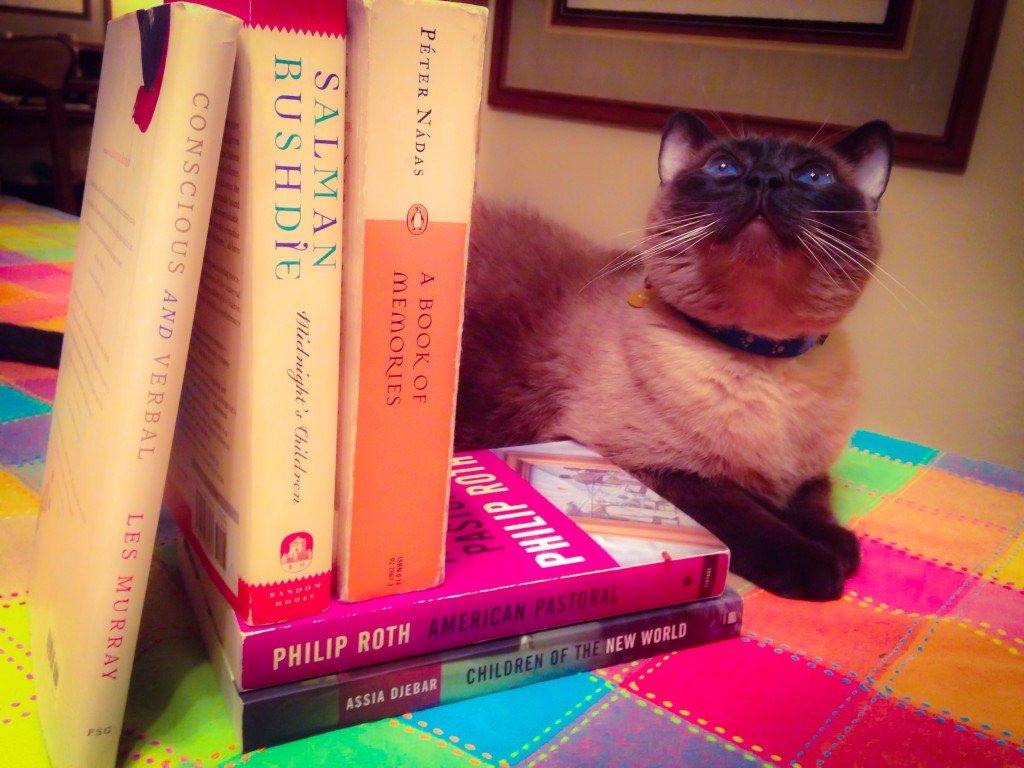
In addition to Salman Rushdie, my 2014 shortlist of Nobelable writers includes three other novelists and a poet. A more stunning group of writers you will never find. Read these experts. Listen, as you read, to how the grief and splendor of living rushes from their words in a spiritual torrent which would wash most of us away if channeled through our own faculties. Listen to how Algerian novelist Assia Djebar evokes the inner life of a “woman of the veil” who has just learned that her husband, a rebel in the Algerian War for Independence, is in grave danger, and chooses to surmount all the prohibitions of her society in order to find and warn him. Australian poet Les Murray is famously querulous, but listen to how in “A Dog’s Elegy” he grows tender, wittily mystical, disarming with image and verbal delight his reader’s defenses against the enormity of death. Listen carefully to Péter Nádas‘s narrator – young, bisexual, Hungarian, hyper-aware – and you’ll hear, in his account of learning to communicate with a young German poet with whom he is in love, the catastrophe of modern Hungary. Listen to Philip Roth, the American perennial, in one of his sublime rants which, as always with him, transcends that descriptor by saying something so heartbreakingly true about human nature that, for all it’s clattering expansiveness, it comes off like Shakespeare. And Salman Rushdie. Listen to him. Am I wrong?
“Small things come in big packages.” —Assia Djebar (b. 1936)
1. Assia Djebar (Algeria)
She’d forgotten the danger itself. In truth, it’s perhaps not that which drove her, but rather a gnawing desire to suddenly know whether she could really spend her life waiting in her room, in patience and love. That’s why she crossed the entire town, bared her presence to so many hostile eyes, and at the end of her trek discovered that she was not only a prey for the curiosity of men — a passing shape, the mystery of the veil accosted by the first glance, a fascinating weakness that ends up being hated and spat upon — no, she now knows that she existed. She’s been inhabited by one inflexible thought that has made her untouchable. “Get to Youssef! He’s in danger,” she had repeated. “But is he, really?” she ended up wondering when she found herself alone on the curb surrendering to, or even beyond, the same fruitless waiting. “Won’t he first of all be shocked to see me here, out in the street?” No, the danger is real.
(Children of the New World)
”Some people are born to fatness. Others have to get there.” —Les Murray (b. 1938)
2. Les Murray (Australia)
A Dog’s Elegy
The civil white-pawed dog who’d strain
to make speech-like sounds to his humans
lies buried in the soil of a slope
that he’d tear down on his barking runs.
He hated thunder and gunshot
and would charge off to restrain them.
A city dog too alive for backyards,
we took him from the pound’s Green Dream
but now his human name melts off him;
he’ll rise to chase fruit bats and bees;
the coral tree and the African tulip
will take him up, and the prickly tea trees.
Our longhaired cat who mistook him
for an Alsatian flew up there full tilt
and teetered in top twigs for eight days
as a cloud, distilling water with its pelt.
The cattle suspect the Dog lives
but three kangaroos stood in our pasture
this daybreak, for the first time in memory,
eared gazing wigwams of fur.
(Conscious and Verbal)
“By fantasizing one builds a more predictable world, and then one has no time to notice what is really happening, because of the din made by one’s expectations crashing down.” — Péter Nádas (b. 1942)
3. Péter Nádas (Hungary)
But as he listened to me, a radically different process was also taking place in him: as usual, he kept correcting my grammatically faulty sentences, he did this almost unawares, it had become an unconscious habit between us; in fact, he was the one who shaped my sentences, gave them the proper structure, incorporated them into the neat order of his native language, I had to rely on his expropriated sentences to work my way through my linguistic rubble, had to use his sentences to tell my story, and didn’t even notice that some of these jointly produced sentences were repeated two or three times, their place and value reshuffled, before reaching intelligible form.
It was as if I had to use my own past to coax the story of his past out of him. I didn’t think of it then, but now I believe we needed these evening walks not just for the exercise but to relate to the world around us — which we both felt, though for different reasons, to be cheerless and alien — and to do it in a way that this same world would not be aware of what we were doing.
(A Book of Memories)
“I write fiction and I’m told it’s autobiography, I write autobiography and I’m told it’s fiction, so since I’m so dim and they’re so smart, let them decide what it is or it isn’t.” —Philip Roth (b. 1933)
4. Philip Roth (United States)
You fight your superficiality, your shallowness, so as to try to come at people without unreal expectations, without an overload of bias or hope or arrogance, as untanklike as you can be, sans cannon and machine guns and steel plating half a foot thick; you come at them unmenacingly on your own ten toes instead of tearing up the turf with your caterpillar treads, take them on with an open mind, as equals, man to man, as we used to say, and yet you never fail to get them wrong. You might as well have the brain of a tank. You get them wrong before you meet them, while you’re anticipating meeting them; you get them wrong while you’re with them; and then you go home and tell somebody else about the meeting and you get them all wrong again. Since the same generally goes for them with you, the whole thing is really a dazzling illusion empty of all perception, an astonishing farce of misperception. And yet what are we to do about this terribly significant business of other people, which gets bled of the significance we think it has and takes on instead a significance that is ludicrous, so ill-equipped are we all to envision one another’s interior workings and invisible aims? Is everyone to go off and lock the door and sit secluded like the lonely writers do, in a soundproof cell, summoning people out of words and then proposing that these word people are closer to the real thing than the real people we mangle with our ignorance every day? The fact remains that getting people right is not what living is about anyway. It’s getting them wrong that is living, getting them wrong and wrong and wrong and then, on careful reconsideration, getting them wrong again. That’s how we know we’re alive: we’re wrong. Maybe the best thing would be to forget being right or wrong about people and just go along for the ride. But if you can do that — well, lucky you.
(American Pastoral)
“What is freedom of expression? Without the freedom to offend, it ceases to exist.” —Salman Rushdie (b. 1947)
5. Salman Rushdie (Great Britain)
Why had she married him?—For solace, for children, But at first the insomnia coating her brain got in the way of her first aim; and children don’t always come at once. So Amina had found herself dreaming about an undreamable poet’s face and waking with an unspeakable name on her lips. You ask: what did she do about it? I answer: she gritted her teeth and set about putting herself straight. This is what she told herself: “You big ungrateful goof, can’t you see who is your husband now? Don’t you know what a husband deserves?” To avoid fruitless controversy about the answers to these questions, let me say that, in my mother’s opinion, a husband deserved unquestioning loyalty, and unreserved, full-hearted love. But there was a difficulty: Amina, her mind clogged up with Nadir Khan and his insomnia, found she couldn’t naturally provide Ahmed Sinai with these things. And so, bringing her gift of assiduity to bear, she began to train herself to love him. To do this she divided him, mentally, into every single one of his component parts, physical as well as behavioral, compartmentalizing him into lips and verbal tics and prejudices and likes…in short, she fell under the spell of the perforated sheet of her own parents, because she resolved to fall in love with her husband bit by bit.
(Midnight’s Children)
The 2014 Nobel Prize for Literature will be awarded soon. Share with us, here at The Shelf: Who do you think will win? (My bets are on Assia Djebar this year.) Who do you think should win?
Societies in which arranged marriages are still prevalent must wonder what all the brouhaha was about when Mo Yan won the Nobel Prize for Literature last year. In some quarters (China) his win was celebrated as if he was a conquering hero on the order of, say, Genghis Kahn. Others, of which yours truly is one, felt his win to indicate, if not actual malignancy at work in the universe, then at least mindless absurdity at work in Stockholm, not least because of his slapdash writing. But societies with arranged marriages must view all this backing and forthing as a curious instance of democratic vanity. In such societies, families pair off boys and girls for marriage, often very early in life, at some point the boy and girl are told of the arrangement, and that is the end of it until the wedding day, unless, as in some cultures, the wedding day is the day of revelation. The pair is either happy about it or not, much to the indifference of those who’ve chosen for them. For it to work – and in many places it has long worked rather well – there must be a broad-based acceptance of a cosmos in which things are given or taken without much regard for the wishes or agency of the ones receiving or yielding. It’s only when love, a human universal, turns to regard itself, and in doing so steps beyond its provenance in the body to style itself as a compelling thought process capable of making vital decisions that people begin to get touchy about who’s being foisted on them.
People who direct their love towards books tend to become deeply attached to certain authors. For such counterculturists, the Nobel Prize can feel rather barbaric. Like an arranged marriage. Once we’ve been handed our winner – because it does feel somehow like a bestowal – our feelings about Stockholm’s choice, approval or dismay, become more at issue than the choice itself. In other words, it becomes all about us.
In about a week that famous secular conclave will meet to decide who to shack us up with this year. Busybody pundits are giving themselves little orgasms asking who, or what kind of writer, it will be. Will it be a captivating storyteller who ravishes her readers with a gorgeously over-stuffed vision of humanity, someone in the line of, say José Saramago or Gabriel Garcia Marquez, or will it be someone whose rewards are cloistered behind a wall of aesthetic that will keep him a rather arcane fetish for a few, someone akin to Claude Simon or Samuel Beckett? Will it be a curiosity, like Dario Fo, or a well known literary force, e.g. Saul Bellow? Another bony Eastern European to join Herta Müller, or a non-colonial African to keep Wole Soyinka company? Will the political objective driving the choice be baldfaced, as with Orhan Pamuk, or restrained, as with Tomas Tranströmer? Male or female? Novelist? Poet? Playwright? Someone uncharacteristically category-defying?
These questions, while entertaining, are really of only passing interest, in the end not much different than church basement gossip. The real question, or the only one that matters to any of us inclined to take an interest, is whether or not when we lift the veil and gaze upon who has been chosen for our regard, we find the face lovely or dispiriting.
Here is a list of five authors I would be more than happy to live with should Stockholm choose them. There are, of course, many others. Philip Roth and Alice Munro don’t appear on my list this year even though I would probably pee myself if either of them made the cut. But they’ve been on my short list for the past two years, and I decided to only put forth candidates who I’ve not put forth before. I would be fascinated if either Kenya’s Ngugi wa Thiong’o or Algeria’s Assia Djebar won, and am eager to get to know their work, but on this list you’ll find only writers I’ve actually read. The Nobel literature prize is always geopolitically interesting: On my list this year, two are Hungarian, one is Australian, one Irish, one Spanish. I’m struck that all my choices are men, and all fiction writers. Call my list one-sided, but these guys are all as good as it gets. I’ve listed them alphabetically because if I were to rank them in order of who I most want to win, they’d all have to pile into a rather ill-suited cluster in the first spot. Along with their names, I offer you a passage from each of their bodies of work. You decide who you would choose. I’m sure I can’t.
László Krasznahorkai (Hungary)
Rubbish. Everywhere he looked the roads and pavements were covered with a seamless, chinkless armour of detritus and this supernaturally glimmering river of waste, trodden into pulp and frozen into a solid mass by the piercing cold, wound away into the distant twilight greyness. Apple cores, bits of old boots, watch-straps, overcoat buttons, rusted keys, everything, he cooly noted, that man may leave his mark by was here, though it wasn’t so much this ‘icy museum of pointless existence’ that astonished him (for there was nothing remotely new about the particular range of exhibits), but the way this slippery mass snaking between the houses, like a pale reflection of the sky, illuminated everything with its unearthly, dull, silvery phosphorescence.The awareness of where he was exercised an increasingly sobering effect on him—he had by no means lost his capacity for calm appraisal—and as he continued to appraise, as if from a considerable eminence, the monstrous labyrinth of filth, he grew ever more certain that, since his ‘fellow human beings’ had utterly failed to notice this flawless and monumental embodiment of doom, it was pointless talking about a ‘sense of community’. It was, after all, as if the earth had opened up beneath him, revealing what lay underneath the town, or, and he tapped the pavement with his stick, as if some terrible putrescent marsh had seeped through the asphalt to cover everything.
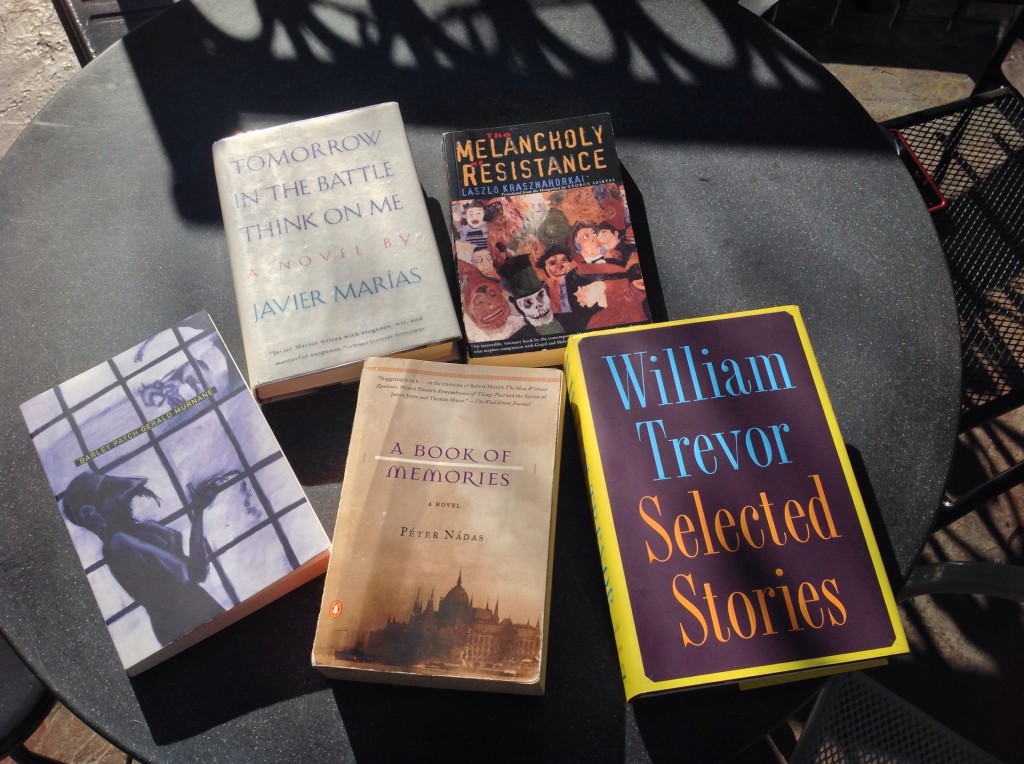
from: The Melancholy of Resistance
Javier Marias (Spain)
“People used to venerate them or at least their memory, and they would go and visit their graves with flowers, and their portraits would preside over their homes,” I thought, “people spent a period in mourning and everything stopped for awhile or slowed down, the death of someone affected the whole of life, the dead person really did take with them a part of the lives of their loved ones and, consequently, there wasn’t such a separation between the two states, they were related and they were less frightening. Now people forget the dead as if the dead were plague victims, sometimes they use them as shields or dunghills in order to blame them and make them responsible for the terrible situation in which they have left us, often they are loathed or they receive only acrimony and reproaches from their heirs, they departed too soon or too late without preparing the ground for us or without leaving us free, they continue being names but not faces, names to which all manner of villainies and cowardices and horrors are imputed, that’s the current tendency, and thus they do not find rest even in oblivion.”
from: Tomorrow in the Battle Think On Me
Gerald Murnane (Australia)
“On that day it appeared that the whole state was alight. At midday, in many places, it was dark as night. Seventy-one lives were lost.” The previous sentences are from a report of a royal commission that followed the bushfires of January, 1939, in the state of Victoria. The day when the bushfires were at there worst was known afterwards as Black Friday. By chance, it was the day when my youngest aunt left the convent that would have overlooked, among much else, the paddock whereon would be lain down fifteen years later a certain street beside which would be built twelve years later again the house in which my aunt’s oldest nephew would live for at least forty years and would write books of fiction, one of the last of which would include a passage in which the narrator, who was wholly lacking in imagination, would report mere details in the hope that fiction truly was, as someone once claimed, the art of suggestion and that some at least of his readers might intuit or divine or suppose, if not imagine, some little of what his aunt had seen or felt on the day when she left the convent where she had hoped to live for the rest of her life.
from: Barley Patch
Péter Nádas (Hungary)
A shipwrecked person whose feet desperately seek something solid to keep him afloat will grab at anything, anyone, the first available object, and if it buoys him up he won’t let it go, he’ll swim with it,and after a time he’ll see he has nothing else! just this? and the object will grimly concur, yes, just this, nothing else! and the implacable impulse of self-preservation, joined of course by rationalization and mystification, will have him believe that the object that drifted his way by chance was really his, it chose him and he chose it, and by the time the sheer force of unrelenting waves casts him onto the shore of mature adulthood, his faith and gratitude will have made him worship what was accidental and adore fortuity, but can his rescue from destruction be really accidental?
from: A Book of Memories
William Trevor (Ireland)
Growing up in the listless nineteen-eighties, Celia Normanton knew her father well, her mother not at all. Mr. Normanton was handsome and tall, with steely gray hair brushed carefully every day so that it was as he wished it to be. His shirts and suits gave the impression of being part of him, as his house in Buckingham Street did, and the family business that bore his name. Only Mr. Normanton’s profound melancholy was entirely his own. It was said by people who knew him well that melancholy had not always been his governing possession, that once upon a time he had been carefree and a little wild, that the loss of his wife – not to the cruelty of an early death but to her preference for another man – had left him wounded in a way that was irreparable.